
Modern American households operate hundreds of sensitive microcontrollers inside kitchen appliances, heat pump compressors, smart lighting circuits, and entertainment systems. Standard point-of-use power strips offer minimal defense against grid disturbances, leaving the main electrical load center exposed to destructive high-energy transient spikes.
Primary Suppression Architecture & Panel Integration
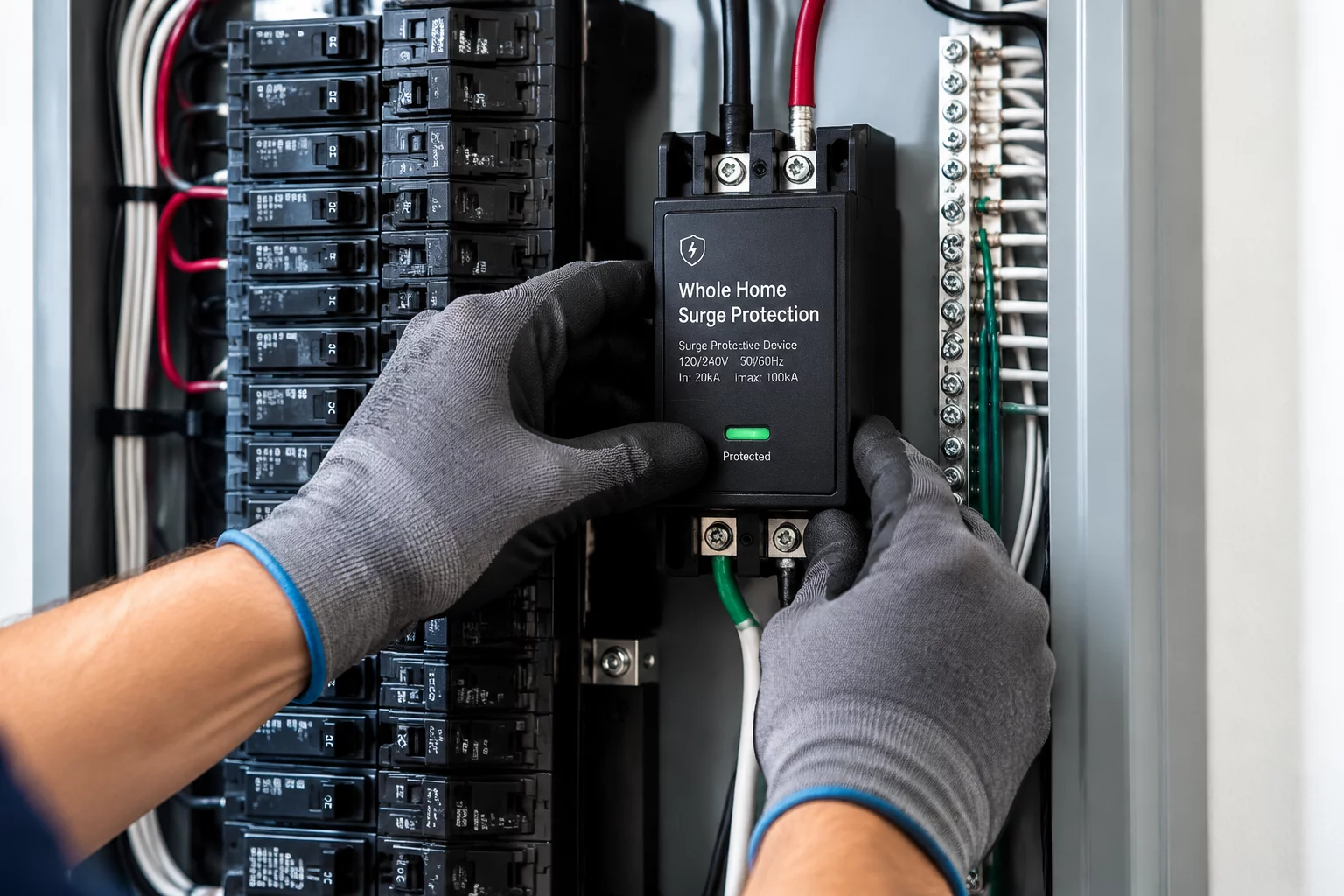
Installing a dedicated whole-home surge protective device (SPD) at the primary breaker panel establishes the first line of defense. The unit connects directly across the dual 120V bus bars, neutral, and equipment ground through a dedicated dual-pole breaker. When overvoltage transients enter through overhead utility service drops or sudden capacitor switching, high-capacity Metal Oxide Varistors (MOVs) within the SPD react instantaneously, conducting the excessive kinetic surge current safely toward the earth grounding electrode before high voltage penetrates branch circuits.
Lead wire length between the surge suppressor and the panel bus bars directly dictates the residual clamping voltage. Every additional inch of conductor increases parasitic inductance by approximately 10 volts per inch during steep surge wavefronts. Panel leads must remain straight, tightly bundled, and under 6 inches in length.
Comprehensive Field Deployment Standards
Our installation methodology follows stringent National Electrical Code (NEC) Article 242 protocols, ensuring absolute structural safety and sustained thermal dissipation during catastrophic transient events:
- Dual-phase clamping coverage engineered for split-phase 120V/240V US residential panels with thermal fusing disconnects.
- NEMA 4X rated weatherproof enclosures suitable for both indoor service basements and outdoor meter combo panels.
- Continuous real-time LED diagnostic status indicators alongside audible fault alarms signaling MOV depletion.
Post-Installation Verification & Long-Term Reliability
Following physical mounting and breaker engagement, our electrical technicians perform detailed resistance-to-ground testing, ensuring ground loop impedance measures well below 25 ohms. Digital diagnostics confirm symmetric phase-to-neutral voltage delivery, zero line-to-ground leakage, and proper polarity alignment across all downstream distribution breakers.
Community Reviews & Diagnostics
Share technical insights & residential installation notes
Marcus Vance
Verified ClientFacilities Director • 400A Service Upgrade Review
The grid fluctuation audit and Type 1 SPD topology recommended by the engineering team resolved our transient surge issues instantly. Their mathematical modeling and load balance analysis saved us an estimated 28% in unneeded panel replacements.
Submit Your Diagnostic Review
Your input is processed and stored locally for electrical quality benchmark tracking.