
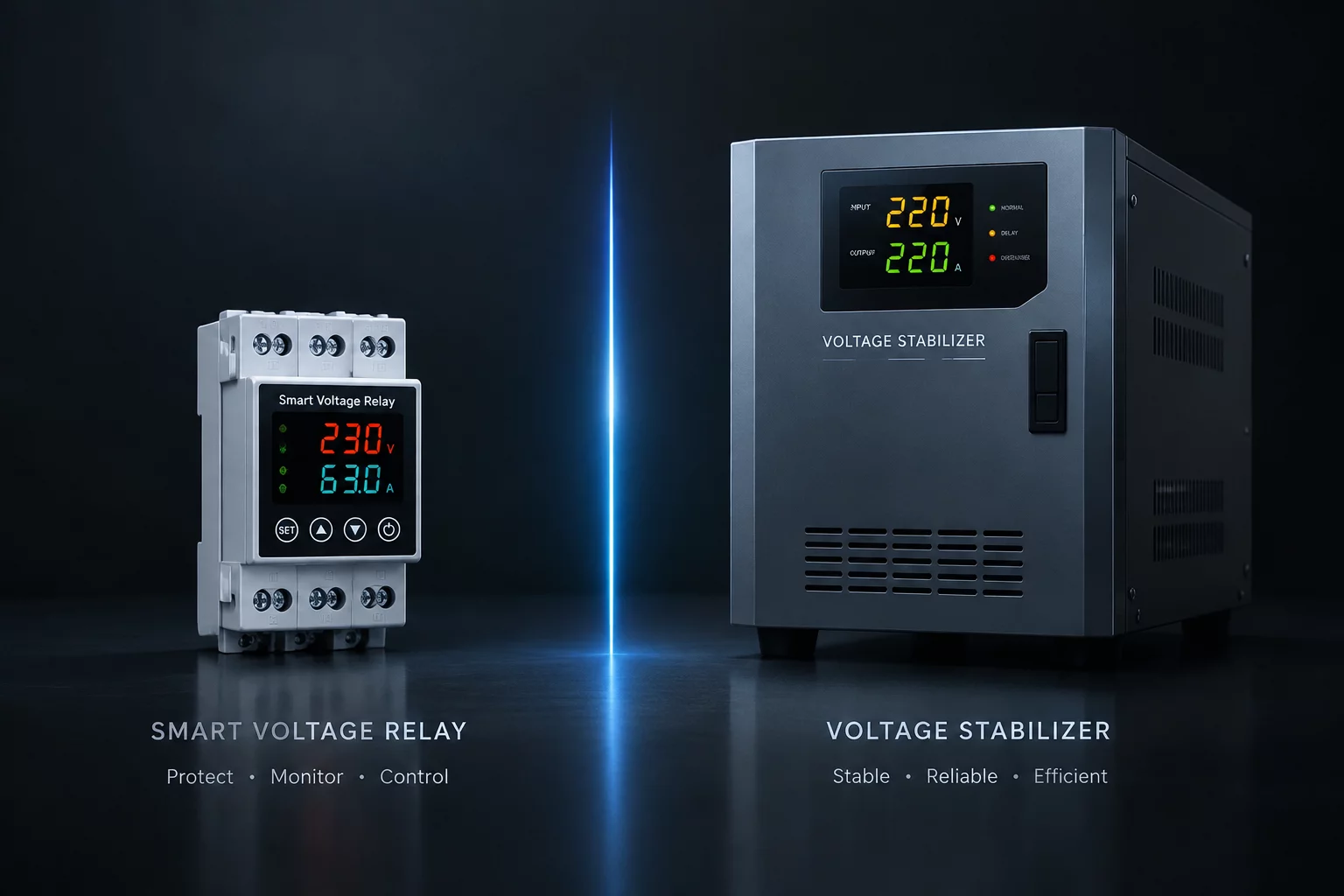
Homeowners dealing with flickering lights, summer brownouts, or sudden utility overvoltages often face a crucial decision: install an automatic voltage relay or invest in a continuous voltage stabilizer. While both devices protect household electronics from destructive grid anomalies, their operating mechanisms, reaction times, and applications differ fundamentally across 120V/240V split-phase systems.
Core Differences in Operational Dynamics
A voltage relay functions as an automated digital switch. It monitors incoming line voltage continuously and disconnects connected equipment within milliseconds whenever voltage drops below or surges above predetermined thresholds. Once grid voltage stabilizes within safe operational tolerances for a configured delay interval, the relay automatically restores power. In contrast, a voltage stabilizer actively modifies incoming voltage through an autotransformer or electronic inverter circuitry, boosting low voltages or stepping down high voltages in real time without cutting power to the house.
Voltage relays provide absolute disconnection protection against catastrophic surges or neutral breaks, whereas stabilizers ensure uptime during sustained utility voltage sag conditions without interrupting delicate operations.
When to Choose a Voltage Relay Over a Stabilizer
Relays are ideal for protecting compressor-based equipment such as air conditioners, heat pumps, and refrigerators from rapid cycling and low-voltage stall overheating. They are compact, mount directly into DIN-rail distribution panels, consume minimal standby power, and react in 10 to 30 milliseconds.
- Ultra-fast disconnection response under 20ms during sudden dangerous line spikes or lost neutral faults.
- Programmable delay timers (up to 600s) to prevent compressor backpressure damage after grid restoration.
- Zero harmonic distortion and near-zero idle energy consumption compared to autotransformers.
Choosing Active Voltage Stabilizers for Chronic Grid Sags
In rural or suburban areas where line voltage drops to 100V during peak summer hours, a voltage relay would shut off appliances constantly, causing severe inconvenience. A servo-controlled or solid-state electronic stabilizer compensates for continuous voltage drift, holding outlet potential at a steady 120V ±2%. For total home safety, many modern installations combine a service entrance surge protective device (SPD), a main voltage relay for catastrophic cutoff, and dedicated stabilizers for high-precision laboratory or audio/video electronics.
Community Reviews & Diagnostics
Share technical insights & residential installation notes
Marcus Vance
Verified ClientFacilities Director • 400A Service Upgrade Review
The grid fluctuation audit and Type 1 SPD topology recommended by the engineering team resolved our transient surge issues instantly. Their mathematical modeling and load balance analysis saved us an estimated 28% in unneeded panel replacements.
James Callahan
Verified ClientHomeowner • Heat Pump Protection Setup
Setting the cutoff relay delay timer to 3 minutes solved our AC compressor short-cycling problem during summer thunderstorm grid drops. The technical explanation in this guide made the sizing and configuration straightforward.
Submit Your Diagnostic Review
Your input is processed and stored locally for electrical quality benchmark tracking.