
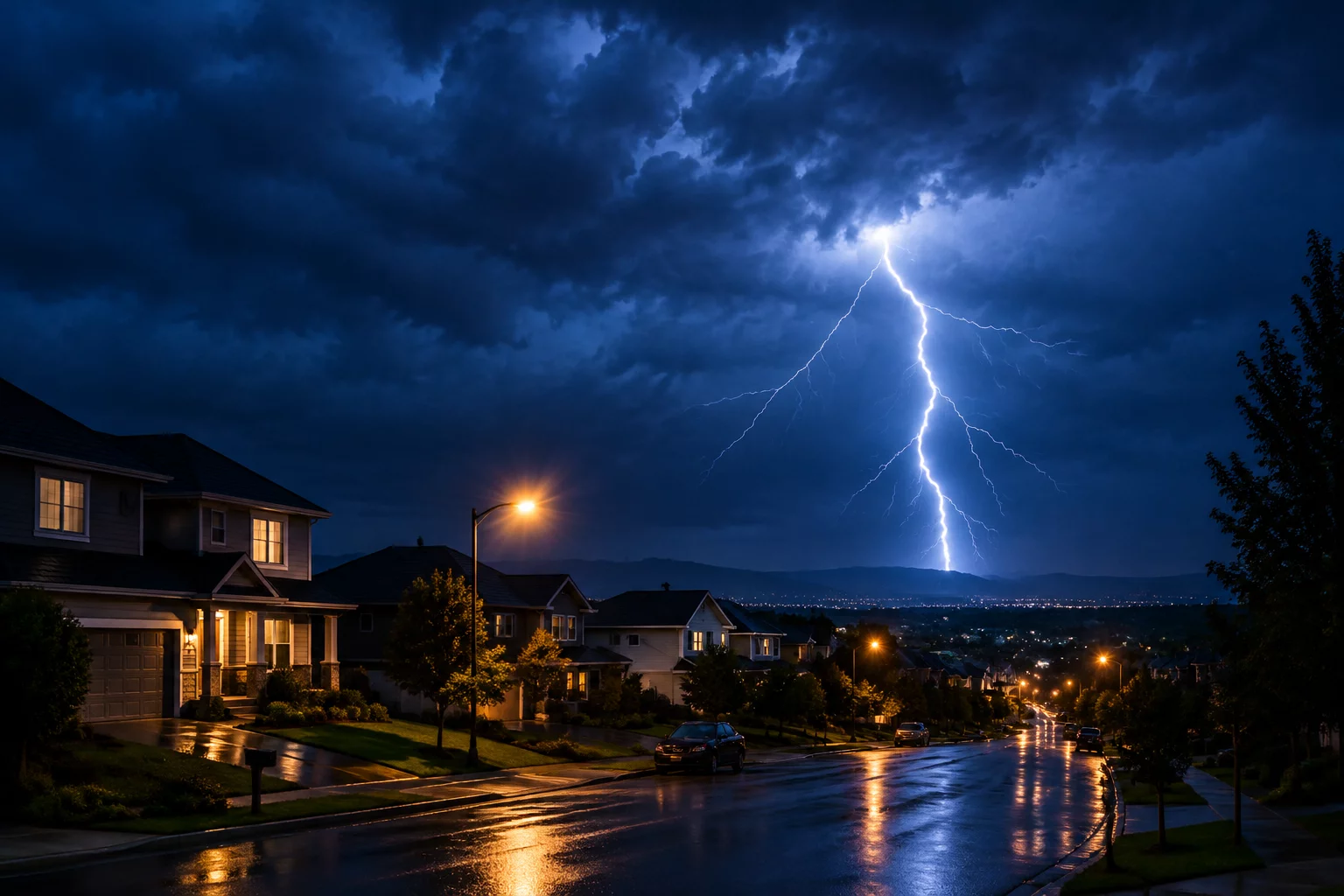
Transient overvoltage events occur silently dozens of times each day across ordinary residential electrical distribution systems. While catastrophic lightning strikes command the most attention, nearly eighty percent of internal voltage transients originate within the home itself through routine inductive load switching. Every time a central heat pump, air compressor, or refrigerator motor cycles on and off, high-frequency voltage spikes propagate down branch circuits.
Anatomy of Transient Voltage: Spikes, Surges, and Sags
In North American residential grids, standard split-phase power operates at a nominal 120 volts AC with a continuous sinusoidal waveform at 60 Hz. A power surge represents a sub-cycle transient excursion that exceeds this threshold significantly, often reaching peaks between 500 and 6,000 volts in mere nanoseconds. Microprocessors and delicate semiconductor gates operate at direct current potentials between 1.8 and 5 volts. When exposed to repeated transient surges, solid-state dielectric layers suffer cumulative microscopic breakdown, resulting in premature device lockups and hardware failure.
According to IEEE Standard 1100 (The Emerald Book), surge protective devices (SPDs) must incorporate fast-reacting metal oxide varistors (MOVs) or silicon avalanche diodes capable of sub-nanosecond response times with low lead inductance to limit residual voltage below the withstand ratings of connected equipment.
Primary Sources of Transient Grid Disruption
Power anomalies enter household circuits through primary AC mains feeds as well as auxiliary conductive pathways including ethernet lines and outdoor wiring. Recognizing where these disturbances originate clarifies why point-of-use plug strips alone cannot ensure total protection:
- Inductive Motor Kickback: High-inrush motors discharge stored electromagnetic fields back into the local panel during sudden de-energization cycles.
- Utility Capacitor Switching: Regional grid operators dynamically switch high-voltage capacitor banks to maintain power factor, releasing sharp transient waves across distribution feeders.
- Indirect Atmospheric Discharges: Cloud-to-ground strikes within one mile induce secondary current loops in overhead transformer neutrals and underground service drops.
Cascaded Defense: Implementing Tiered Surge Protection
Total protection requires a coordinated multi-tier suppression architecture. Type 1 surge devices installed upstream at the meter base or main service entrance divert high-energy exterior impulses directly to ground. Downstream Type 2 devices integrated into the branch panel clamp remaining transient spikes to manageable thresholds. Finally, Type 3 surge filters placed directly at vulnerable equipment locations eliminate local switching noise, ensuring complete end-to-end security for modern connected homes.
Community Reviews & Diagnostics
Share technical insights & residential installation notes
Marcus Vance
Verified ClientFacilities Director • 400A Service Upgrade Review
The grid fluctuation audit and Type 1 SPD topology recommended by the engineering team resolved our transient surge issues instantly. Their mathematical modeling and load balance analysis saved us an estimated 28% in unneeded panel replacements.
Arthur Pendelton
Verified HomeownerSmart Home Setup • Dual Subpanel Protection
We experienced repeated smart switch failures after lightning storms until we added a dedicated Type 2 surge protector in our primary panel alongside voltage relays. Not a single automation glitch since the upgrade.
Submit Your Diagnostic Review
Your input is processed and stored locally for electrical quality benchmark tracking.